
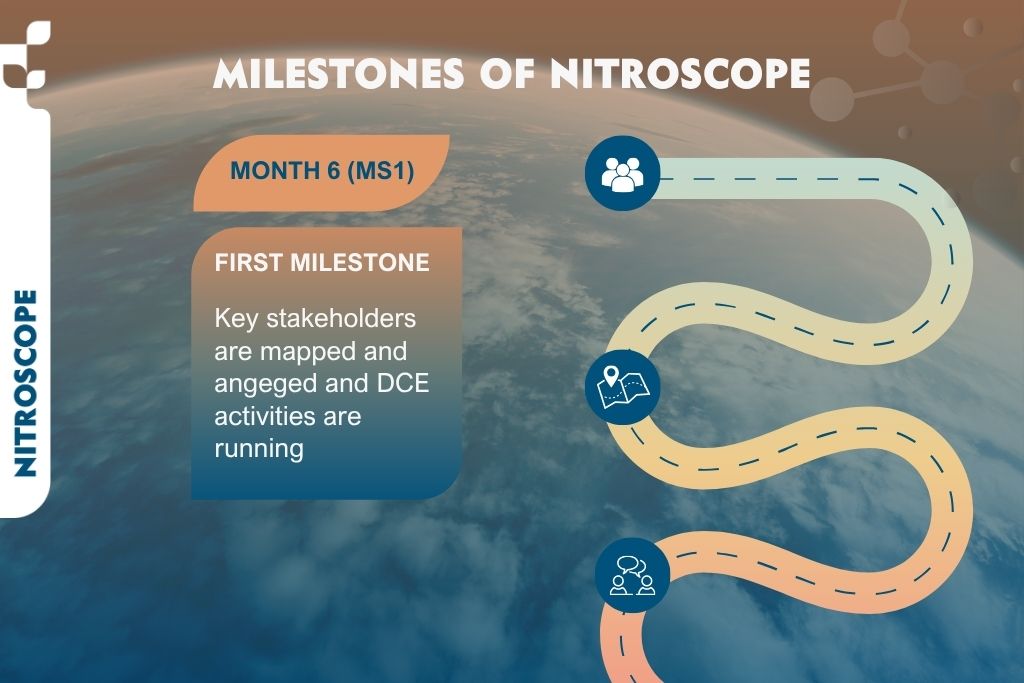
NitroScope has successfully achieved its first project milestone, marking an important step in building meaningful participation around the project’s research and innovation activities.
Key stakeholder groups have now been identified and mapped, creating a clear foundation for engagement throughout the project. This work will help ensure that NitroScope remains connected to the people and organisations involved in nitrogen management, sustainable agriculture, environmental monitoring and policy development.
Building the foundation for stakeholder engagement
Improving nitrogen management requires collaboration across the agricultural and environmental sectors. Farmers and land managers apply nitrogen management practices in the field. Advisors support agricultural decision-making. Researchers develop and test new approaches. Industry representatives contribute technologies and practical solutions, while policymakers help create the conditions for wider implementation.
For this reason, identifying and understanding the project’s stakeholder groups is an essential early step. The stakeholder mapping process connects farmers, advisors, researchers, policymakers, industry representatives and other relevant actors with NitroScope’s activities. It provides a structured basis for communication, consultation and knowledge exchange during the project.
MS1 includes tasks across WP4 and WP7
The achievement of Milestone 1 was supported through two work packages.
IRI leads Work Package 4: Improving adoption of nitrogen management and conservation strategies. Its work focuses on understanding the factors that influence whether sustainable nitrogen management practices are accepted and adopted in real agricultural settings.
ena Development Consultants leads Work Package 7: Communication, Dissemination and Exploitation. WP7 is responsible for ensuring that project activities, knowledge and results reach relevant audiences and contribute to long-term scientific, environmental, policy and practical impact.
The connection between these two Work Packages is particularly important. Stakeholder engagement helps the project understand the needs, expectations and challenges of different groups, while communication and dissemination activities ensure that information reaches them in an accessible and relevant way.
Creating two-way communication
Stakeholder engagement is more than sharing information about the project.
It also creates opportunities for farmers, advisors, researchers, policymakers and industry representatives to contribute their knowledge and perspectives. Their input can help NitroScope better understand real-world conditions and ensure that its research responds to practical needs.
At the same time, NitroScope’s communication, dissemination and exploitation activities are now underway. These activities will support the visibility of the project, promote access to its knowledge and create stronger connections between research, agricultural practice and policy.
This two-way exchange will help ensure that stakeholder input feeds back into the research and contributes to the development of relevant and usable project outcomes.
Moving from mapping to engagement
With the main stakeholder groups identified and the project’s communication, dissemination and exploitation activities in progress, NitroScope can now build on this foundation through continued engagement and knowledge exchange.
The next steps will focus on strengthening relationships with relevant actors, gathering insights from different stakeholder groups and ensuring that project developments are communicated clearly throughout Europe.
Achieving Milestone 1 represents an important beginning for this process. It brings NitroScope closer to its goal of turning scientific knowledge into practical solutions for more efficient nitrogen use, reduced environmental losses and more sustainable agricultural systems.