
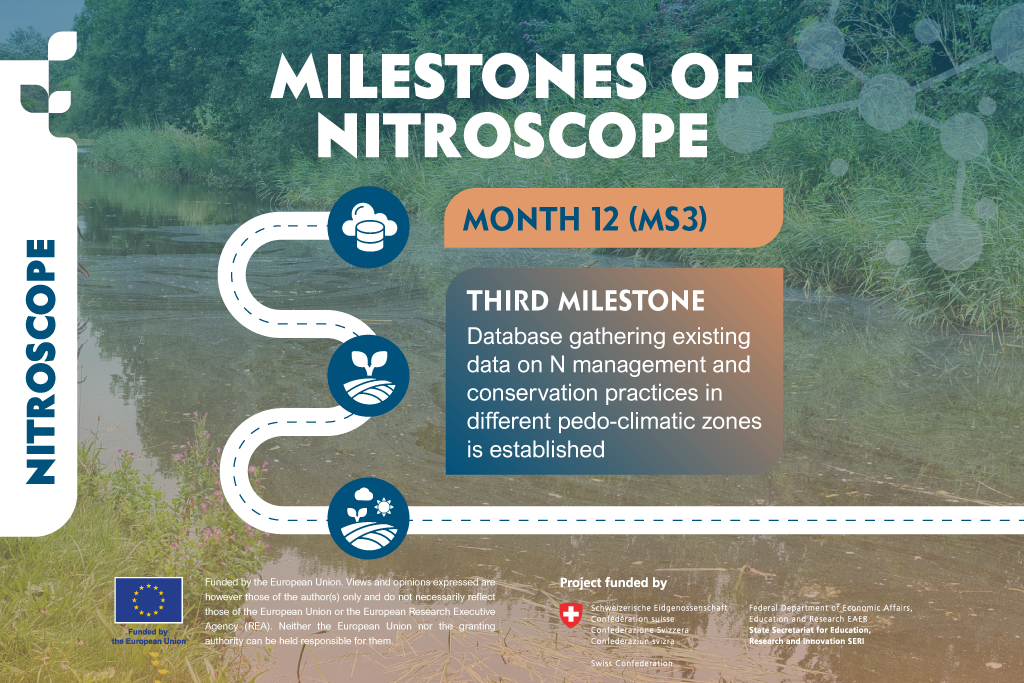
NitroScope has reached its third project milestone, marking an important step towards building a stronger European knowledge base for sustainable nitrogen management.
The milestone focuses on establishing a database that brings together existing data and metadata on nitrogen management and conservation practices across different European pedo-climatic zones.
By organising information from previous research and field experiments, NitroScope is laying the groundwork for a better understanding of how nitrogen behaves under different agricultural and environmental conditions.
Bringing existing nitrogen data together
Across Europe, nitrogen management practices differ depending on local soil characteristics, climate, cropping systems and farming approaches.
A considerable amount of information already exists through agricultural experiments, long-term research and monitoring activities. However, differences in how these data are collected, described and organised can make comparisons between studies challenging.
Through Task 2.1 – Collection and analysis of existing European data on nitrogen management at field scale, NitroScope is working to bring this existing evidence into a more consistent and structured framework.
Led by the Walloon Agricultural Research Centre (CRA-W), with contributions from project partners, the work draws on historical field experiments, long-term studies, existing databases and relevant European research initiatives.
The database is designed to bring together both data and metadata, supporting the comparison of nitrogen management practices across different European agricultural environments.
Supporting research across the project
Milestone 3 contributes to Work Package 2 (WP2) – N-flux sensing strategy definition, led by Hahn-Schickard.
The establishment of the database provides an important foundation for several interconnected research activities.
The information gathered through Task 2.1 will help support the development of data acquisition and management strategies under Task 2.2, as well as future field monitoring and modelling activities across NitroScope.
It will also contribute to the assessment of agricultural practices and the identification of knowledge gaps concerning nitrogen losses and management approaches in different European regions.
A meta-analysis is being prepared to examine evidence from existing studies and better understand how agricultural management practices influence nitrogen losses under different conditions.
These activities will help guide the project’s next steps, particularly as NitroScope continues collecting new field measurements and developing approaches for understanding nitrogen fluxes.
Building the foundations for better nitrogen management
Understanding nitrogen dynamics across Europe requires more than measurements from individual fields.
It also requires combining existing knowledge, identifying where information is missing and developing approaches that allow data from different locations and research activities to be used together.
By establishing a structured foundation for existing nitrogen-related data, Milestone 3 represents an important step in connecting previous research with NitroScope’s ongoing monitoring, modelling and nitrogen management activities.
As the project progresses, this work will support the development of scientific evidence needed to improve Nitrogen Use Efficiency, reduce nitrogen losses and promote more sustainable agricultural practices across Europe.